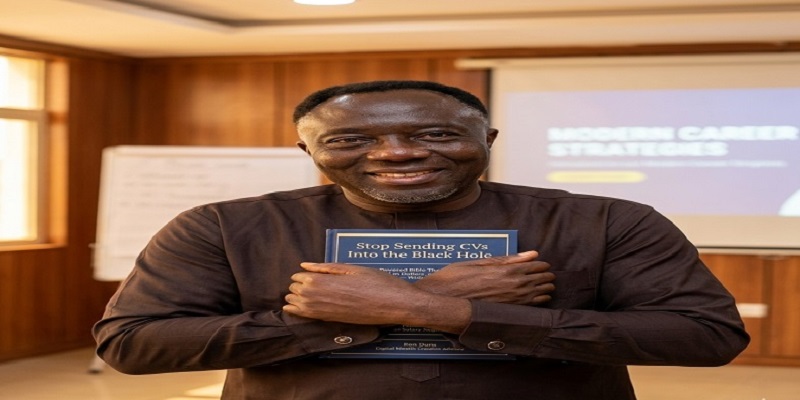
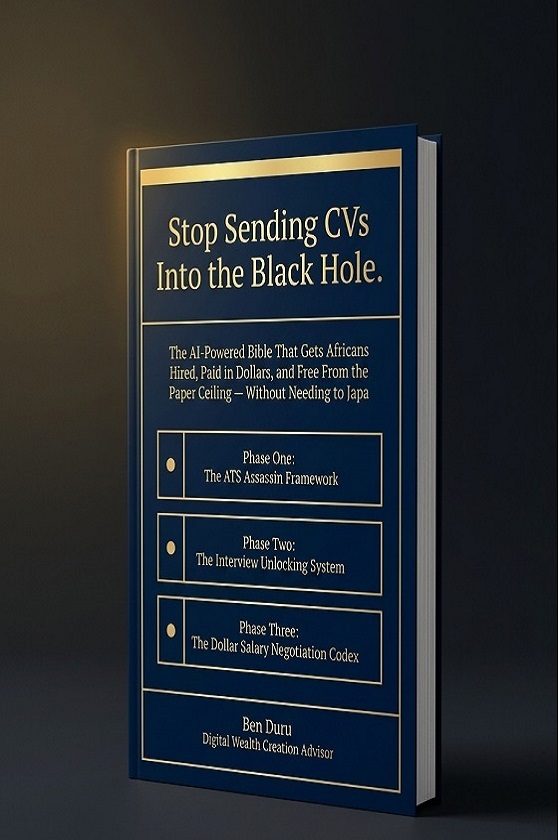
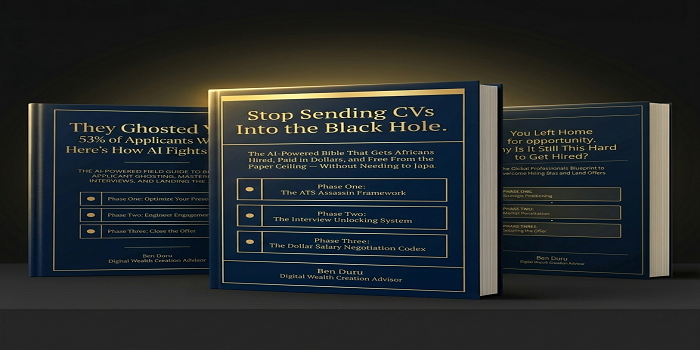
How I Went from Smart, Qualified, and Still Unemployed — to a System That Actually Works
Let me tell you a story I don't share in professional settings.
A few years ago, I made a decision that I believed would open new doors. I had spent over a decade as a technical trainer and industrial engineer. I had worked across Nigeria, had a growing list of certifications, and was delivering training to hundreds of professionals. By any rational measure, I had a strong career.
But I could see where the world was going. Remote work. Dollar-paying international contracts. AI-driven workplaces. The digital economy was creating opportunities that didn't care about geography — and I wanted a piece of them. Not for greed. For freedom. For my family. For the financial stability that a naira salary alone was no longer providing.
So I did what any logical, capable professional does.
I updated my CV. I refreshed my LinkedIn. I started applying.
And then the silence began.
Application after application. Role after role. International companies, local companies, NGOs, tech firms, training organisations. I kept a spreadsheet. I checked the boxes. I tailored my cover letters. I sent connection requests. I waited.
Nothing.
Some applications received automated rejections within seconds. Literally — seconds. No human being had time to read my name, let alone my fifteen years of experience, in under five seconds. I was being eliminated by something I couldn't see.
The Emotional Cost No One Talks About
I won't pretend my home life was unaffected. My wife, Nneka, is an observant woman. She says very little, but she watches everything. After weeks of seeing me at the laptop at eleven at night, refreshing the same inbox, she sat beside me one evening and placed her hand on the table.
"Ben... are you okay? Not the career part. Just you."
I didn't have a clean answer for her. Because the truth was that the confidence I had built over fifteen years — the confidence that comes from being genuinely good at something — was quietly dissolving. And I didn't understand why, because I didn't yet understand the machine that was defeating me.
The Breaking Point
The confrontation that changed my direction came from an unexpected source — my cousin Emmanuel, a sharp young man in Lagos who works in tech and has an opinion on everything.
He was looking at my CV on his screen while we talked on the phone. After a long silence, he said:
"Uncle, this CV is excellent for 2015. But in 2026, the first reader is an algorithm. And this algorithm is rejecting you before a human even opens the file."
I started to argue. My credentials were strong. My experience was real. Surely—
"Stop. Listen to me. The ATS doesn't care about your years. It looks for specific keywords in specific places. Yes, you heard me right. Currently, keyword is everything. Your CV doesn't have them. That is the entire problem."
I sat quietly for a long time after that call.
Every Failed Solution — And Why Each One Let Me Down
Like most people, I did what felt logical. I tried everything available. Here is the honest account:
My career as a tech journalist. I spent months writing about AI tools for other platforms. I understood the technology. But I was writing about tools for other people's careers while missing their application entirely in my own. The cobbler had no shoes.
Seven CV rewrites. I redesigned my CV repeatedly — Canva templates, Word templates, two different paid CV services. None of them knew what ATS optimisation meant. I was creating beautiful documents that were completely invisible to the machine.
Failed interview after failed interview. The few times I got through, I wasn't ready. I had prepared my experience, not my delivery. I talked too much. I gave stories that were true but not structured for what interviewers were listening for. I didn't know the STAR framework. I didn't know how to compress fifteen years into a sixty-second impact statement. I failed interviews I should have won.
Jobs I should have gotten. I found out later that three roles I was genuinely perfect for went to people with less experience. The difference was not competence — it was visibility, positioning, and how their application read to both the machine and the human. I had the substance. They had the system.
Facebook ads and sales page copy. When I tried to build a side income through digital marketing to supplement everything, I struggled badly with copywriting. I spent money on ads that produced nothing because I didn't know how to make words work in a sales context. Again a matter of valuable keywords!
Online course creation. I had the knowledge and the delivery skills. But every time I tried to build a structured online course, I hit a wall — recording quality, editing software, curriculum structure, scripting. What should have taken three weeks took seven months and was still not right.
Each failure fed a quiet, growing fear: Maybe this digital world has a door that doesn't open for people like me.
The Mentor Who Changed the Frame
My breakthrough didn't come from a paid course. It came from a conversation at an L&D training workshop in Lagos — one of those full-day events where people break into working groups over lunch. I ended up sitting next to a young woman named Chidinma. She was 28. She had been working remotely for a UK-based company for two years. She was earning in pounds. She had never left Nigeria.
I asked her carefully — very carefully, because pride made me frame it as curiosity — how she had done it.
She laughed. Not unkindly. Then she said something that rearranged everything:
"Oga Ben, with all due respect — you've been trying to get a job the 2015 way in a 2026 market. The machine sees your CV before any person does. The job you want isn't always posted publicly. But AI can find it for you. Your problem is not your experience. Your problem is that you are completely invisible online to the people who would hire you. And visibility is the easiest thing to fix."
I said something like: "But I know about ChatGPT. And I've played with it."
She shook her head. "Playing is not the same as prompting. Prompting is a skill. You need the right prompts, not just the tool."
I spent the rest of that lunch asking questions and writing notes on my phone. I went home that evening and tried the first prompt she described on my own CV summary. And for the first time in months, I felt something shift. Not a result yet — but the certainty that I had been looking in the wrong direction this entire time.
The First Two Weeks — and the Doubt
I won't lie. The first week was still frustrating. The system was working — the output was genuinely better than anything I had produced myself. But I was still learning the rhythm. I was rebuilding my LinkedIn from scratch. I was learning which platforms to use for which types of roles.
By day six, my wife, Nneka, appeared at the office door.
"Still at it?"
"Still at it," I said. "But I think this is actually different."
She didn't say anything. She brought tea, which, for her, is the equivalent of I believe you.
The Breakthrough
It was a Thursday evening, end of week two.
I had applied for a remote technical training role — an international company in the Netherlands, advertising on LinkedIn. I used the complete system for the first time: AI-rebuilt CV with the exact ATS keywords from the job description, an AI-written cover letter calibrated to the company's tone, LinkedIn profile updated to reflect the same keywords, and a cold outreach message sent to the hiring manager before submitting the formal application.
Two days later, an email arrived. Not automated. Not a template. A real message, from a real person, with a real name — asking me to schedule a video interview at my convenience.
I sat back in my chair. I closed my eyes. It sounds like a small thing — one email. But after months of silence, it felt like the walls of the room becoming solid again. Like I had become real to the world.
Nneka's Reaction
I called her in from the kitchen and showed her the email on the screen. She read it twice. Then she looked at me, and the quiet tension I hadn't even noticed she was carrying — released.
She said exactly this: "Oh my goodness. I'm so glad that you finally hit the right button. Congratulations for putting yourself on the path of real discovery."
I cannot agree less.
Three Others Who Used the Same System
After my own results came in, I began sharing the approach with people in my professional circle. Three of them:
Amara, 27, Port Harcourt. Eighteen months without a job offer after graduating. She rebuilt her CV and LinkedIn in one afternoon using the AI prompts. Ten days later, her first interview request arrived. She was hired three weeks after that.
Kelechi, 34, Lagos. A freelance writer who had been dramatically undercharging on Upwork. After using the system to rebuild his profile and proposal templates, he landed his first dollar-paying client at four times his previous rate.
Ifeoma, 42, Abuja. A retired civil servant who started a freelance service on Fiverr following the side hustle chapter. Within six weeks she had three paying international clients. She now earns more in one month than she previously earned in three.
None of these people are exceptional cases. None of them had connections. None of them needed to japa. They just needed the right tools and the right prompts.